“ATM Skimming” The magnetic stripe—the unassuming black strip on the back of your debit or credit card—remains the Achilles’ heel of modern banking. Despite the rapid adoption of EMV chip technology and contactless payments, the magnetic stripe persists in billions of transactions daily. Because of this legacy infrastructure, ATM skimming remains one of the most lucrative and prevalent forms of fraud in the global financial ecosystem. It is a sophisticated game of physical deception that doesn’t require hacking a bank’s mainframe, only compromising the user at the point of interaction.
The Physical Man-in-the-Middle Attack
At its core, ATM skimming is a localized Man-in-the-Middle (MITM) attack. In the digital realm, a MITM attack intercepts data packets between a client and a server. In the physical world of ATM terminals, the attack works on the exact same principle: the attacker inserts themselves between the entity withdrawing cash (the victim) and the transaction processor (the ATM).
The victim believes they are interacting directly with the machine. However, they are actually interacting with a composite of devices: a fraudulent card reader over the genuine slot and a hidden PIN capture mechanism. The attacker’s equipment piggybacks on the legitimate hardware, harvesting sensitive data invisibly. The transaction then completes normally, leaving the victim none the wiser while the attacker walks away with the keys to their account.
The Arsenal: Equipment Breakdown
Successful skimming operations rely on a specific set of hardware components designed to mimic the original ATM interface while capturing raw data.
1. The Magnetic Stripe Reader (The Skimmer)
This is the primary component. It is a device that fits over the ATM’s card reader slot. Inside, it contains a magnetic read head capable of scanning the stripe as the card is inserted. Professional-grade skimmers often come with built-in memory (microSD cards) or wireless transmitters (Bluetooth) to send data directly to an operator’s mobile device in real-time.
2. The PIN Capture Device
A transaction is useless without the Personal Identification Number. Two primary methods exist to steal this data:
- Hidden Cameras: A small, high-resolution camera is concealed in a strategic location—often inside the ATM’s brochure holder, mounted in the ceiling tile, or disguised as part of the card reader housing. It records the user’s fingers as they tap the keypad.
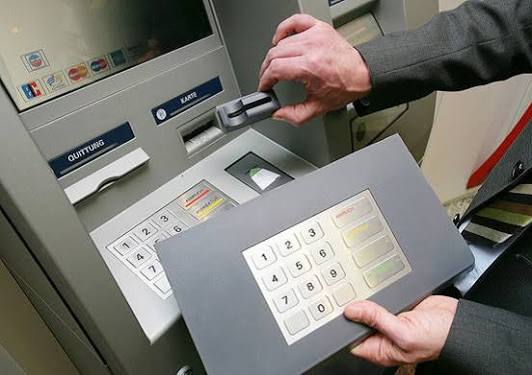
- Keypad Overlays: A more advanced method involves a shell that sits on top of the real keypad. These overlays use capacitive sensors or mechanical switches to record keystrokes. They look indistinguishable from the original keypad but capture every input.
Operational Workflow: From Setup to Cash-Out
The execution of a skimming operation is a disciplined process involving reconnaissance, deployment, extraction, and exploitation.
ATM Skimming
Phase 1: Target Selection and Reconnaissance
Not all ATMs are created equal. Attackers look for “low hanging fruit”—machines in high-traffic areas that are older models or poorly maintained. Gas stations, strip malls, and standalone ATMs are prime targets because they often lack the security monitoring found in bank branches. Operators conduct physical reconnaissance to determine the specific model of the reader (often 3D printed to ensure a perfect fit) and identify blind spots for camera placement.
Phase 2: Deployment
Once the target is chosen, the hardware is attached. This is a rapid process. Skimmers are often held by magnets, adhesive, or friction fit. The PIN overlay is snapped over the existing keypad simultaneously. The goal is seamless integration; the user should not notice the difference between the fake and the real hardware.
Phase 3: Data Harvesting
With the devices in place, the operation enters passive mode. Every card inserted is scanned, and every PIN is recorded. Data can be stored locally on the skimmer’s internal memory or streamed via Bluetooth. Operators may monitor this data remotely, checking the collection rate in real-time to ensure they haven’t missed any transactions.
RELATED: The Anatomy of a Digital Heist – Mastering the Modern ATM Skimmer in a Crypto-Driven Economy
Phase 4: Extraction and Cloning
Once a sufficient amount of data has been gathered, the operator returns to retrieve the hardware. The data is extracted from the skimmer. It is then uploaded to a computer equipped with a magnetic card encoder (card writer). Using blank magnetic cards (typically CR80 size), the operator encodes the stolen Track 1 and Track 2 data onto the blanks. These blanks now function as clones of the victims’ cards.
Phase 5: Liquidation (The Cash-Out)
The final step is withdrawing funds. Cloned cards are used immediately to maximize potential gains before banks flag the unusual activity. This process is often distributed using money mules—individuals hired to withdraw cash from multiple locations or ATMs—to distance the funds from the original point of fraud.
Technical Deep Dive: Data Encoding and Capture
To understand the mechanism fully, one must look at the data itself. The magnetic stripe on a card is divided into three tracks, though only two are typically used in card transactions.
- Track 1: Encoded in LRC format, contains the cardholder’s name, primary account number (PAN), expiration date, and service code. It is prone to less error but carries more descriptive data.
- Track 2: Encoded in LRC format, contains the primary account number, expiration date, and service code. It is the standard track used for authorization and is more robust against data corruption.
- Track 3: Rarely used; contains additional account information and discretionary data.
The skimmer’s magnetic head must align perfectly with this stripe to read the binary data accurately. If the read head is misaligned or of low quality, the data will be corrupted, rendering the clone useless. Professional operators use high-precision heads to ensure 100% data retention.
VERIFIED SHOP
Summary: Comparison of PIN Capture Methods
The effectiveness of a skimming operation often depends on the PIN capture method used. Below is a breakdown of the two primary techniques.
| Feature | Hidden Camera | Keypad Overlay |
|---|---|---|
| Detection Difficulty | Moderate (requires visual inspection) | High (looks like original hardware) |
| Installation Complexity | High (requires precise angle/positioning) | Moderate (direct replacement) |
| Data Reliability | High (records entire screen touch) | High (records physical key press) |
| Common Hiding Spots | Ceiling, brochure slot, fake panel | Direct overlay on existing keypad |
| Cost | Low to Moderate | Moderate |
Frequently Asked Questions
Q: Can a skimmer use a card to get cash itself?
No. A skimmer is a passive capture device. It reads the data but lacks the ability to initiate a transaction or dispense cash. It relies on a human operator to clone the card and use it later.
Q: How long does a skimmer stay active?
This varies based on the storage capacity of the device. Basic units with microSD cards might be retrieved after a few hours, while more advanced Bluetooth-enabled skimmers can run for days, transmitting data live to the operator’s phone.
Q: Are magnetic stripe cards becoming obsolete?
While EMV chips offer superior security, magnetic stripe fallback is still mandatory in many jurisdictions for backward compatibility. As long as ATMs accept the fallback option (where a chip card is swiped if the chip reader fails), cloned magnetic cards remain a viable threat.
Q: What is “Fullz”?
In the context of skimming, “Fullz” refers to a complete set of stolen identity information for a specific individual. This typically includes the bank account number, PIN, CVV code, and sometimes the individual’s full name, date of birth, and address, all derived from the skimming operation.
Q: How do criminals launder the cash?
Cash obtained from cloned cards is often difficult to track immediately. Criminals use techniques such as purchasing goods with high street value (like electronics), using money transfer services, or converting cash into cryptocurrency to obscure the origin.
Ready to move beyond theory? For verified, high-quality cards and fullz, visit cvvdump.com or buyccfullz.site. Real data, reliable service, and the tools you need to execute at the highest level.