“Skimming”, You tap your card against the terminal. It beeps. You get your coffee. You assume you’re safe. You assume the chip or the contactless wave has finally defeated the plastic bandits of the past.
While the financial world has largely moved toward EMV chips and biometric authentication, the reality in 2026 is more complex. The “old school” magnetic stripe skimmer isn’t dead—it’s evolved. It has become microscopic, wireless, and nearly invisible. The thieves haven’t stopped stealing data; they’ve just gotten much better at hiding in plain sight.
If you think your debit card is secure just because it has a chip, you need to understand how modern card skimming technology works.
VERIFIED SHOP
Why Skimming Still Exists in 2026
You might wonder, “Why bother with a skimmer when almost everyone uses cards with chips or phones?”
The answer lies in infrastructure. While consumer habits have shifted, the hardware in many places lags behind.
- Legacy Fallbacks: Many international ATMs, self-service kiosks, and gas pumps in Southeast Asia, Eastern Europe, and even some budget retailers in the US default to magnetic stripe reading if a chip isn’t detected.
- Tourist Targeting: Visitors often use their cards in unfamiliar systems that rely on the older stripe technology.
- The “Hybrid” Threat: A sophisticated attacker might use a device that reads both the chip and the magnetic stripe simultaneously, ensuring they capture data regardless of how the card is presented.
The Modern Skimmer’s Arsenal
Gone are the days of bulky plastic shells glued over card readers. The 2026 skimming scene is dominated by precision engineering and wireless data transmission.
1. The “Ghost” Insertion (Deep Insert Skimmers)
This is the stealthiest form of skimming. Instead of sitting on top of the reader, these devices are 3D-printed to fit inside the card slot.
- How it works: They sit flush against the internal mechanics. When you insert your card, the skimmer reads the magnetic stripe data as it enters the machine.
- The Data Transfer: These devices often connect via Bluetooth Low Energy (BLE). They transmit data to a waiting receiver held by an accomplice nearby, or they have internal storage that is retrieved later.
- Visibility: Almost impossible to see without physically dismantling the machine.
2. The Overlay Skimmer
These are the physical covers you might still remember, but they are lighter and more durable.
- Evolution: Modern overlays use advanced materials that mimic the texture and color of the original terminal.
- Keypad Integration: Older overlays required you to lift a flap to type your PIN. Newer models are “all-in-one,” meaning the skimmer has its own keypad that records your PIN as you type, blending seamlessly with the real buttons.
- Battery Life: Newer models feature micro-power sources that can keep the device recording for up to two weeks without a recharge.
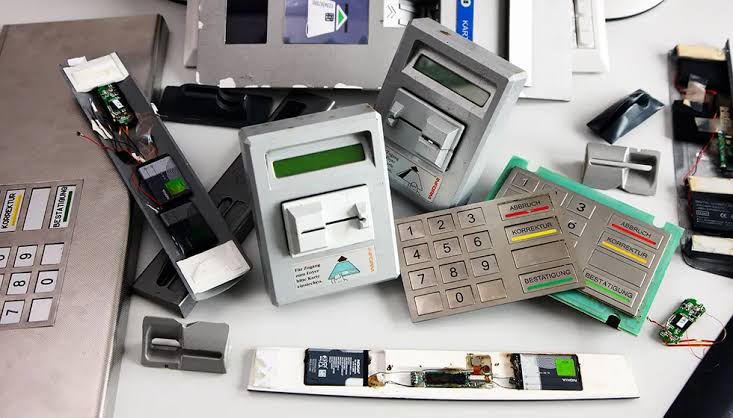
ATM SKIMMING
3. NFC and RFID “Proximity” Skimmers
With the rise of contactless payments, thieves have developed devices that look like legitimate NFC readers but sit idle until a phone or card comes within range.
- The Setup: A fake charity donation box or a hidden relay station near a subway turnstile can act as a skimmer.
- The Capture: It steals the card number and expiration date instantly when you tap to pay.
- The Risk: Because the transaction is often under a dollar, you might not notice the discrepancy until your bank statement arrives days later.
4. Bluetooth “Drop Box” Terminals
This is a high-tech approach where the skimmer acts as its own receiver.
- Placement: A small receiver is hidden inside a backpack, under a table in a cafe, or inside a parked car.
- Collection: The skimmer at the ATM stores data locally and syncs it with the drop box. The thief can then walk up to the drop box and download every card captured that day in seconds.
Case Studies: How It Happens in Action
The Miami Beach Heist
In a high-profile operation, a skimming ring targeted a nightclub ATM. They didn’t use a simple overlay. They used a deep-insert skimmer equipped with a tiny camera embedded in a screw head near the PIN pad. Over three nights, they captured the magnetic stripe data and the PINs of 400 customers. The data was transmitted to a receiver in a passing car, allowing the thieves to clone cards and drain accounts before the victims woke up the next morning.
RELATED: Revised Bitcoin Carding Instructions 2026 –The Coin base Approach
The Tokyo Commute
In a busy Tokyo train station, commuters were tapping their cards to exit the subway. An attacker placed a fake NFC relay device on top of a legitimate ticket machine. When a commuter tapped their card, the device relayed the signal to the attacker’s device, which then relayed it back to the station’s reader to open the gate. The commuter paid twice—the first time for their ride, the second time for the thief.
The Tech Behind the Theft
The tools used by modern criminals are impressive pieces of engineering.
- MSR606 Clones: These are handheld devices that encode stolen magnetic stripe data onto blank cards. In 2026, these are compact enough to fit in a pocket.
- 5G Relay Modules: Some advanced skimmers use 5G connections to send data directly to the cloud, bypassing the need for an accomplice to be nearby.
- Self-Wipe Firmware: To avoid detection, some high-end skimmers include sensors. If the device is unplugged or tampered with, the memory automatically erases itself.
How to Spot a Skimmer (The 2026 Checklist)
You can protect yourself by treating every ATM and card reader like a potential crime scene.
- The Wiggle Test: Gently wiggle the card reader. If it feels loose, has gaps, or moves more than the machine itself, it likely has an overlay skimmer on top.
- The “Built-in” Keypad Check: Look closely at the number pad. Do the keys look raised or recessed in a way that feels different from other ATMs? Tilt your head to see if there’s any reflection that suggests a camera lens above the keypad.
- Cover the PIN: Always cover your hand when entering your PIN. Assume every ATM has a camera.
- Go Indoor: Skimmers are most common on street-facing ATMs where access is easy. Indoor ATMs in banks or grocery stores are monitored and less likely to be tampered with.
- Check the Receipt: Compare your receipt to the transaction on your app. If the amount is higher than you expected, there might be a fake reader.
Summary: Skimmer Types in 2026
| Skimmer Type | Location | Technology | Stealth Level | Primary Data Captured |
|---|---|---|---|---|
| Deep Insert | Inside card slot | BLE / Internal Memory | Very High | Track 1 & 2, PIN |
| Overlay | Top of card reader | Internal Memory / Camera | Medium-High | Track 1 & 2 |
| NFC Mimic | Near terminal | Proximity Relay | High | Card Number, Expiry |
| Fake Terminal | POS device | Mobile App / Clone | High | Full Card Data |
Frequently Asked Questions
Q: Can Apple Pay or Google Pay be skimmed?
A: Generally, no. These digital wallets use tokenization, meaning they generate a unique code for every transaction. Skimmers read physical magnetic strips, not the radio signals from your phone.
Q: Do chip cards protect against skimmers?
A: Partially. Chip cards have an embedded microchip that generates a unique code for every transaction, which makes them very difficult to clone. However, if the machine reads the magnetic stripe as a fallback, a skimmer can still capture that data.
Q: What should I do if I notice a skimmer?
A: Do not use the machine. Cover the camera lens if you have a business card or note. Report the device to the bank or location immediately.
Conclusion
In 2026, the battle against card theft has moved into the realm of microscopic sensors and wireless frequencies. The physical bulky skimmers are relics, replaced by devices that look like they belong inside the machine. The best defense is vigilance—checking for wobbly readers, covering your PIN, and trusting your instincts when something feels off at the checkout. Stay aware, and keep your financial data secure.